
Ultrasecure Linux network
IOTHIC kin establishes trust between Linux nodes without stored credentials.
kin is a secure network you install on the Linux devices that form your environment. Add a device by approving it and running a one-line script on the host.
Trust between nodes uses Continuous Proof of Trust (CPT), built on IOTHIC's patented protocol. Only approved, verified devices can communicate on the network. That removes man-in-the-middle attacks, stolen passwords, and a class of credential-based attacks.
Ultrasecure Linux network
IOTHIC kin establishes trust between Linux nodes without stored credentials.
kin is a secure network you install on the Linux devices that form your environment. Add a device by approving it and running a one-line script on the host. Trust between nodes uses Continuous Proof of Trust (CPT), built on IOTHIC's patented protocol. Only approved, verified devices can communicate on the network. That removes man-in-the-middle attacks, stolen passwords, and a class of credential-based attacks.
Iothic kin is an ultra secure network which you can start installing in minutes on the devices which form your secure Linux network. As you add more devices you simply approve and run a one line script on each additional device that wishes to join the network.
Trust between Linux nodes is established using Continuous Proof of Trust (CPT), which we have built using our revolutionary patented protocol.
CPT ensures that only approved and verified devices are trusted and allowed to communicate within the network. This prevents man-in-the-middle, stolen password, and a whole category of other attacks
Read more here about the benefits of Iothic kin and how it works

Available on the US Government GSA Schedule
Procure kin through Carahsoft on the GSA Schedule.
The problem
Post-quantum risk is already here
Harvest-now, decrypt-later collection means traffic captured today may be decrypted when large-scale quantum attacks become practical. Any system deployed now that must stay secure for ten years is already in scope. This is not a future planning exercise. The transition window is open now.

INTEGRATORS



THREE HORIZONS This is not a sudden problem. It has been building for years.
Post-quantum is not a planning exercise. Anything you deploy today that needs to be secure in ten years is already subject to harvest-now, decrypt-later collection. The transition window is not ahead of you.
It is already here.

THE INSIGHT
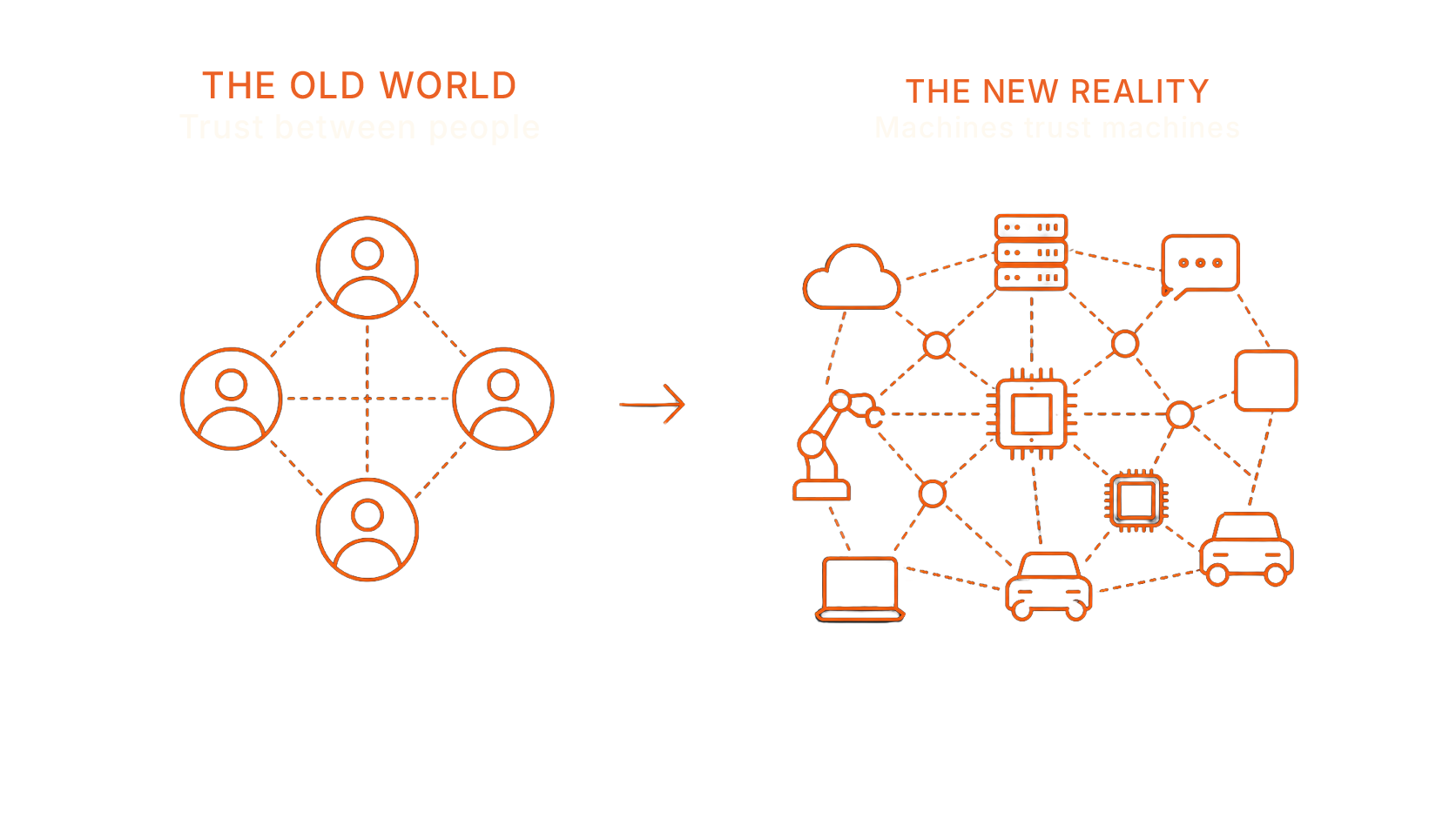
The problem is not that credentials are too easy to steal
The problem is that credentials exist at all.
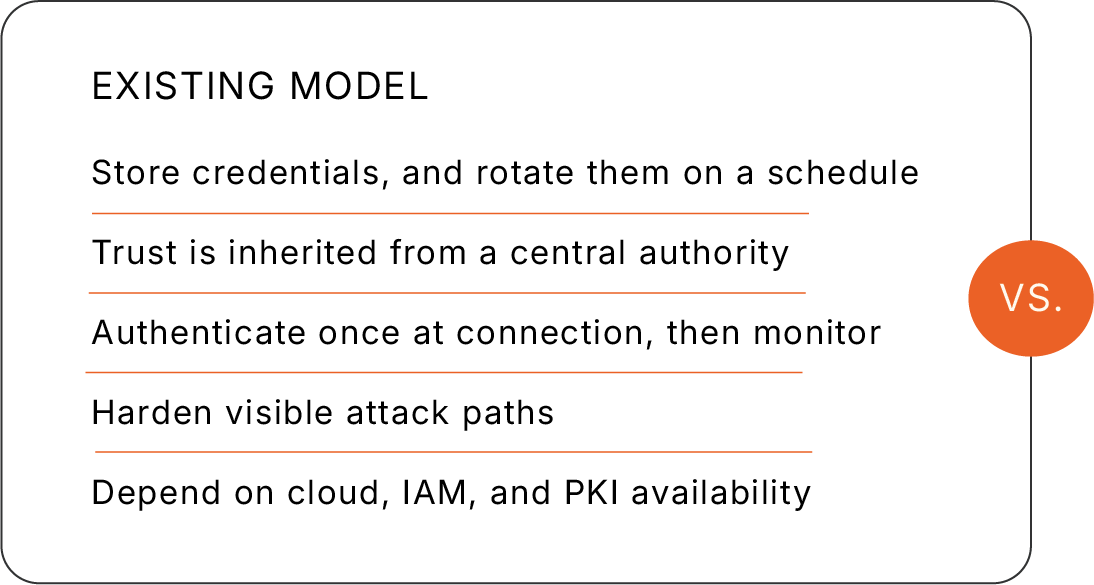
Every security framework built around credential management is optimizing the wrong variable. It assumes that persistent secrets are necessary and works to protect them more effectively. The real question is whether a system can prove trust without generating anything worth stealing in the first place.

THE CATEGORY
Continuous Proof Trust™
Not a better lock. The elimination of what makes locks necessary.
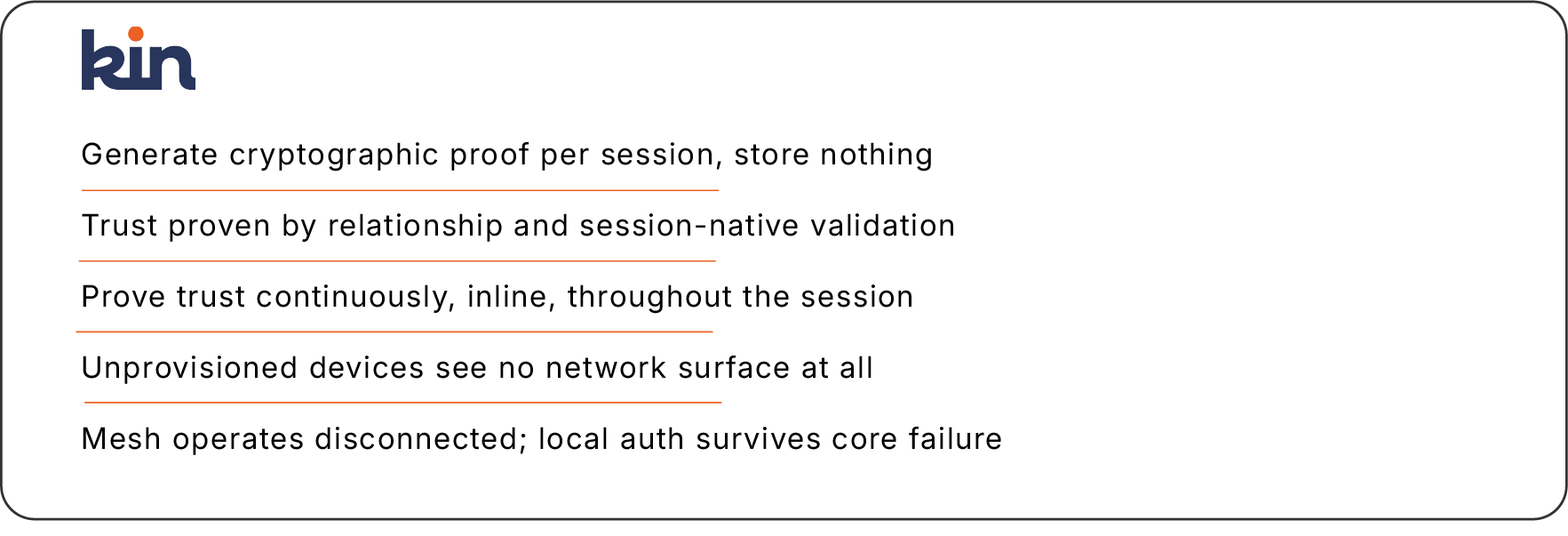
Continuous Proof Trust™ is a new category in which trust is not stored, inherited, or assumed. It is generated fresh for each session, cryptographically verified throughout its duration, and destroyed the moment the session ends. There is no credential to rotate. No certificate to revoke. No long-lived secret to harvest.

kin is IOTHIC's implementation of that category. It gives machines, workloads, devices, and autonomous systems a way to continuously prove trust without relying on stored credentials, reusable secrets, or a central authority.
In fact, the proof is user-defined
THE TRANSFORMATION
What changes when the trust model changes?
When a system proves trust continuously rather than presenting a stored credential, a few things follow directly.

Session-native identity
Ephemeral keys are generated per session and destroyed at close. Nothing remains to be harvested.

Continuous proof inline
Authentication runs throughout the session, not only at the gate. A drifting device can be quarantined mid-session.

Nefarious behavior
Unprovisioned devices receive zero network visibility. The surface is not hardened. It is absent.

Distributed mesh trust
No single authority. No single point of cascade failure. Mesh nodes authenticate independently during connectivity loss and reconnect when it resumes.
The software is under 8MB . It compiles into existing stacks.
Built on NIST-approved standards.
Modular cryptographic libraries enable post-quantum algorithm updates without re-architecture.
Designed for the constraints of actual environments, including 15-year-old or warrantee protected equipment and devices.
WHY WE BUILT IOTHIC
“The research became a company because the problem was bigger than academia.”
IOTHIC began at the University of Oxford with a question most security architectures were never designed to answer:
What happens when stored credentials are removed from the trust equation entirely?
Nearly a decade of research led to the creation of the decentralized Open Interoperable Security Protocol and a new approach to Zero Trust: Continuous Proof Trust™.
Today, that research powers kin™.
Trust is not inherited. It is continuously proven.