Advancing Protection of SASE
By Mykhailo Magal, PhD, Head of Research and Development, Iothic Ltd.
How kin strengthens edge-cloud-edge security with Continuous Proof Trust
Secure Access Service Edge changed how organizations think about network security. It brought together identity, policy enforcement, traffic inspection, cloud-delivered access, and software-defined connectivity into a more flexible model for users, applications, branches, cloud services, and edge environments.
That change matters. But SASE does not automatically solve the trust problem underneath every connection. In many deployments, access decisions still depend on stored credentials, certificates, reusable tokens, centralized identity assertions, or key management systems that must be issued, protected, rotated, and revoked.
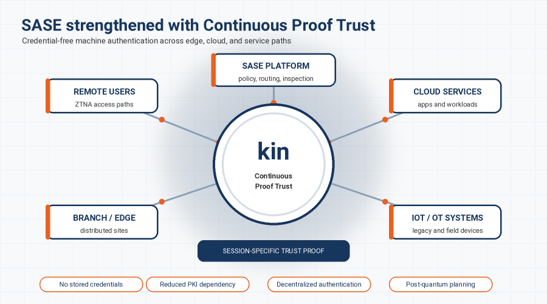
Iothic kin strengthens that layer. It gives SASE providers and enterprises a way to add credential-free machine authentication into dynamic edge-cloud-edge environments, using Continuous Proof Trust instead of inherited trust artifacts. The objective is not to replace SASE. The objective is to make SASE harder to bypass, easier to operate, and more resilient as networks become more distributed.
Where SASE remains exposed
SASE improves control, especially when compared with older perimeter-heavy security models. It can reduce sprawl, consolidate policy, and provide more consistent protection across users, branches, cloud applications, and remote environments.
The exposure sits deeper in the architecture. If authentication still depends on a certificate, shared secret, token, directory assertion, or centrally managed key, then the SASE control plane still inherits the same credential risk that attackers already exploit.
This becomes more difficult at the edge. Devices may be intermittently connected. Industrial and IoT systems may be difficult to update. Remote sites may need to continue operating even when central services are unavailable. In those conditions, traditional PKI and centralized key management can become both an operational burden and a security dependency.
The shift kin makes
kin changes the trust model by moving machine authentication away from static or reusable credentials. Instead of asking whether a stored artifact appears valid, kin asks whether the participants in the interaction can prove themselves cryptographically at the moment trust is required.
That proof is session-specific. It is generated for the interaction, used for the interaction, and becomes useless outside that context. This reduces the value of interception, replay, credential theft, and unauthorized reuse.
For SASE, this creates a stronger foundation. Policy enforcement remains important, but it is supported by a machine-executed trust layer that does not treat a certificate or token as valid simply because it was issued earlier.
Continuous Proof Trust across edge-cloud-edge paths
SASE environments are not static. A single business process may involve a remote user, an identity provider, a cloud application, a branch edge device, an API, and a workload running in another cloud region. Each point on that path can become an opportunity for abuse if trust is granted once and then taken for granted.
Continuous Proof Trust makes verification native to the interaction. Authorized participants prove themselves during the communication flow rather than relying solely on a prior login, a standing certificate, or a reusable authentication token. The result is a trust model better aligned with the way modern distributed systems actually operate.
This is especially relevant for machine-to-machine traffic. SASE is often discussed through the lens of user access, but the harder problem is the growing volume of automated communication between services, devices, workloads, gateways, and edge systems.
Reducing PKI and key management burden
Conventional SASE deployments can depend heavily on public key infrastructure, certificate authorities, and key management infrastructure. These systems work, but they create administrative overhead and high-value trust anchors. Certificates must be created, distributed, renewed, monitored, and revoked. Keys must be protected. Mistakes are common and expensive.
kin reduces that burden by removing dependence on stored credentials as the basis of ongoing authentication. Trust does not have to be inherited from a certificate that may have been issued months or years earlier. It can be established through a live cryptographic proof between authorized participants.
This does not mean existing SASE infrastructure has to be ripped out. kin can be introduced as a strengthening layer, as part of a gateway deployment model, or through deeper OEM integration where the SASE provider wants credential-free machine trust as a native product capability.
Stronger segmentation and lateral movement control
Segmentation is one of the practical security benefits SASE promises. But segmentation is only as strong as the trust model used to decide which entities are allowed to communicate. If an attacker can misuse a credential or impersonate an authorized node, segmentation controls can be weakened.
kin supports a more restrictive model. Authenticated participants only communicate with the entities and network segments they are provisioned to access. Unauthorized communication attempts do not become a negotiation with a visible service. They fail because the required trust proof cannot be produced.
That has direct value in reducing lateral movement. A compromised endpoint, stolen credentials, or exposed tokens become less useful when the attacker cannot produce the session-specific proof needed to establish trusted communication with other systems.
Securing OT, IoT, and legacy edge systems
The SASE challenge is not limited to office users and cloud applications. Many organizations are extending secure access models to operational technology, industrial IoT, remote infrastructure, logistics sites, substations, manufacturing lines, building systems, and other environments where devices are not easily modified.
A gateway deployment model allows kin to protect communications around sensitive or legacy systems without forcing a redesign of the underlying device software. This is useful for PLCs, industrial controllers, sensors, field devices, and other systems where operational continuity matters as much as security.
For SASE providers, this is an important extension point. It creates a path to serve environments where cloud-delivered policy alone is not enough, because trust problems also exist between machines within the edge environment.
Post-quantum planning without a SASE rebuild
Long-term SASE strategy also has to account for the cryptographic transition. Organizations are already being asked to understand where vulnerable cryptography exists, where key exchange occurs, and how their systems will migrate toward post-quantum readiness.
kin aligns with that planning by using modern cryptographic mechanisms and avoiding the permanent exchange or storage of reusable authentication secrets as the core trust artifact. In practical terms, that gives SASE providers a way to position stronger machine trust without asking customers to rebuild the entire access architecture.
The most defensible message is not that post-quantum risk disappears overnight. The stronger message is that kin gives SASE architectures a cleaner path away from credential-dependent trust and toward session-specific proof.
Why this matters for SASE vendors
For a SASE vendor, kin can be positioned as a product advantage rather than a separate customer integration burden. It can become a strengthening layer inside the platform, an OEM capability, or a targeted integration for the highest-risk communication paths.
The messaging is straightforward: SASE controls access, but kin proves the machine relationship behind the access. That distinction matters in markets where buyers are already hearing the same language from many vendors about Zero Trust, cloud security, and policy enforcement.
Credential-free machine trust gives a SASE provider a sharper claim. It addresses the trust substrate below the policy. It also creates a credible answer for edge autonomy, OT connectivity, machine-to-machine authentication, and post-quantum planning.
The future of SASE with kin
The next stage of SASE will not be defined only by better dashboards, broader policy coverage, or more consolidated inspection. Those capabilities matter, but the larger question is whether the trust model underlying the architecture can withstand credential theft, replay, impersonation, and connectivity disruptions.
kin gives SASE a stronger answer. By replacing static trust artifacts with Continuous Proof Trust, kin turns authentication from a one-time credential check into a live proof between authorized participants.
That is the real advancement for edge-cloud-edge security: not more dependence on credentials, certificates, and central trust anchors, but less.
Key takeaways
SASE improves security architecture, but it can still inherit credential, certificate, token, and centralized key management risk.
kin strengthens SASE by adding credential-free machine authentication through Continuous Proof Trust.
Session-specific cryptographic proof reduces the value of interception, replay, stolen credentials, and unauthorized reuse.
Gateway deployment models can help protect OT, IoT, PLC, and legacy edge systems without redesigning device software.
For SASE vendors, kin can become a differentiated OEM or embedded capability rather than a standalone customer burden.